Social resistance reduces the impact of pension reform by a quarter
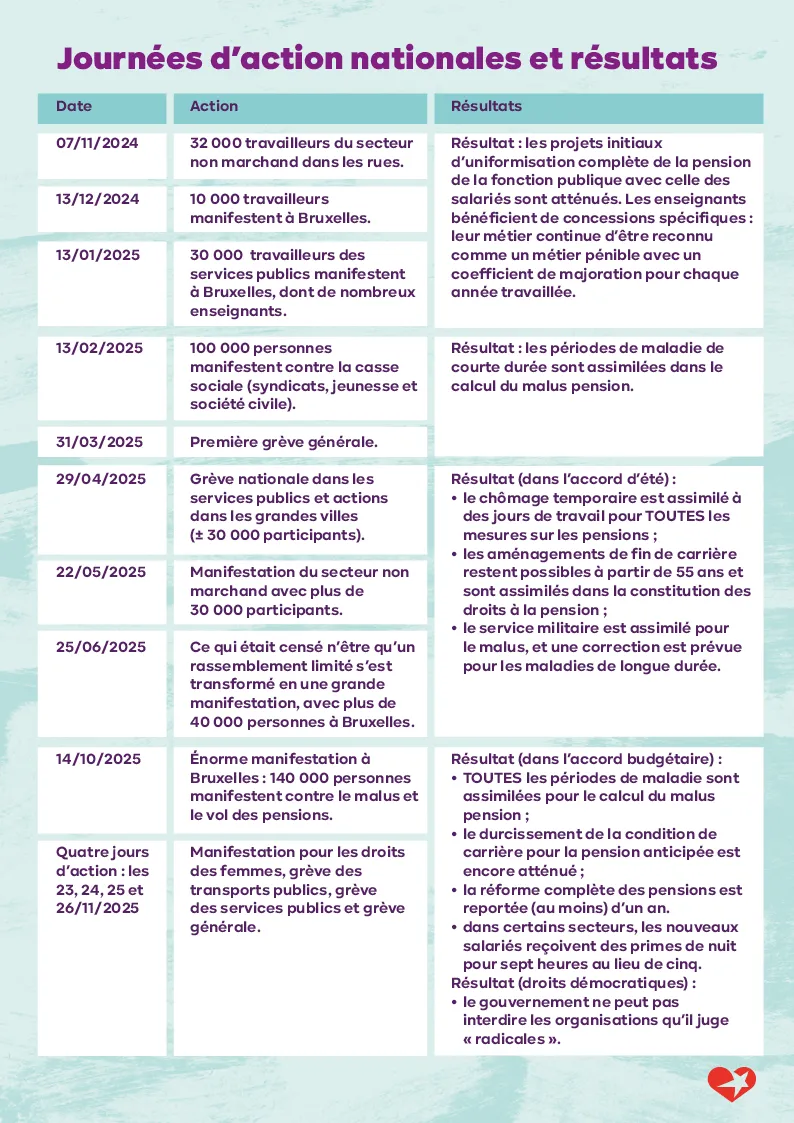
Thirteen days of nationwide action took place against the 'Arizona' government named after the colours of the Arizona state flag, symbolising the 5 parties in the coalition government: N-VA (Flemish right-wing nationalist party), CD&V (Flemish Christian democrat party), Vooruit (Flemish socialist party), MR (French-speaking liberal party) and Les Engagés (French-speaking Christian democrat party). At the heart of many of these mobilisations is the fight against plans to dismantle our pension scheme. Under pressure from below, the government had to review its reform. The pension malus1 and the tougher conditions for early retirement have been mitigated. As a result, the impact of these measures has been reduced by around a quarter. The figures we requested from Pensions Minister Jan Jambon clearly show that the social struggle is paying off.
Thirteen days of nationwide action took place against the 'Arizona' government named after the colours of the Arizona state flag, symbolising the 5 parties in the coalition government: N-VA (Flemish right-wing nationalist party), CD&V (Flemish Christian democrat party), Vooruit (Flemish socialist party), MR (French-speaking liberal party) and Les Engagés (French-speaking Christian democrat party). At the heart of many of these mobilisations is the fight against plans to dismantle our pension scheme. Under pressure from below, the government had to review its reform. The pension malus [1] and the tougher conditions for early retirement have been mitigated. As a result, the impact of these measures has been reduced by around a quarter. The figures we requested from Pensions Minister Jan Jambon clearly show that the social struggle is paying off.
"This proves what we have been saying for a long time: social resistance gets things moving," our MP and pensions expert Kim De Witte explains. "Pressure from below forced the government to back down. Today, all periods of illness and temporary unemployment are taken into account in calculating the pension malus, which has been postponed by at least one year. As a result, nearly 20,000 people will not have to pay a penalty on their pension. Numerous other measures have also been toned down or eliminated."
"It's not over yet," stresses Kim De Witte. "Despite this victory, almost one in four workers who cannot work until 67 will still suffer a pension penalty. Among women, the proportion is even higher. More than one in three women will be affected."
He adds: "The bonus-malus system is unfair. It penalises people who start work early, often in arduous occupations and with lower pensions, and rewards people who start work later and already have a good pension."
On the democratic front too, social resistance forced the De Wever-Bouchez government to make a first concession.
With the Quintin law, the government grants itself the power to ban organisations, without any other form oftrial and without a judge. Under sustained pressure from a coalition of trade unions, human rights organisations, civil society organisations, constitutional experts and the PTB, the Arizona government was forced to back down.
The power to definitively ban an organisation would fall to a judge. However, even after these modifications, the Quintin law poses a danger to our right of association.
The days of action that have taken place are proof that it is necessary and useful to continue building social resistance.
"The government is wavering and is changing its plans under pressure from the streets," concludes Kim De Witte. "Now it's time to go one step further. The pension reform must be completely swept off the table. This is the only way to protect the right to a dignified pension for all."
Here's an overview of all the days of action and the concrete victories they achieved
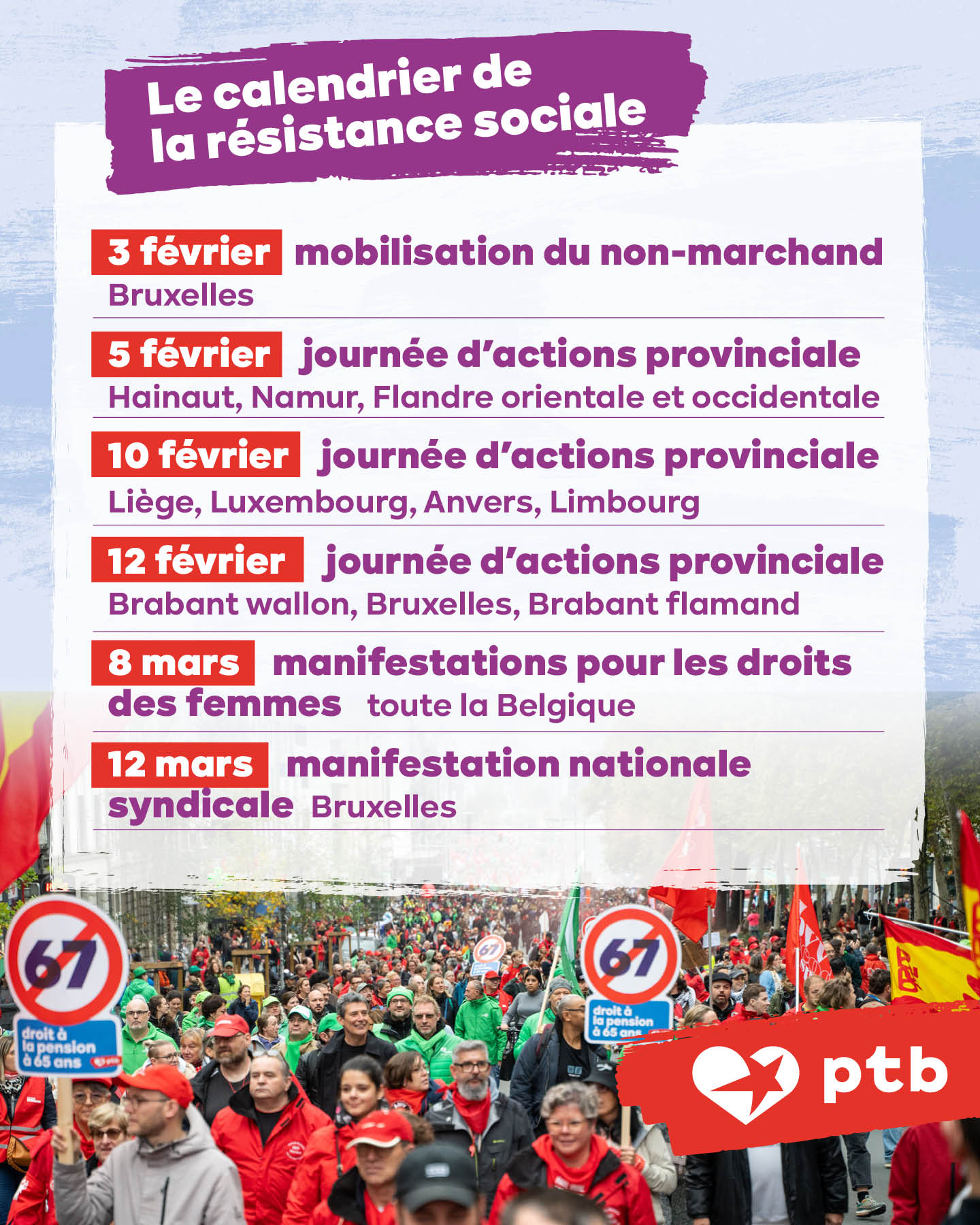
The social resistance calendar in 2026
A lot will be happening in the weeks and months ahead. In 2025, social resistance has shaken the government, and in 2026, the struggle continues to push it back once and for all. Here's an overview of actions already planned.
[1]The government wants to force as many people as possible to work until 67. To impose this, they created the "pension malus". With this malus, your pension could be reduced by5% for each year of pension taken before the age of 67. For each year you retire earlier than the legal retirement age of 66 or 67 (from 2030), you will receive a penalty of -2% until 2030, -4% until 2040, and -5% after 2040.