European Industry Summit: the economic and political elites' shock therapy
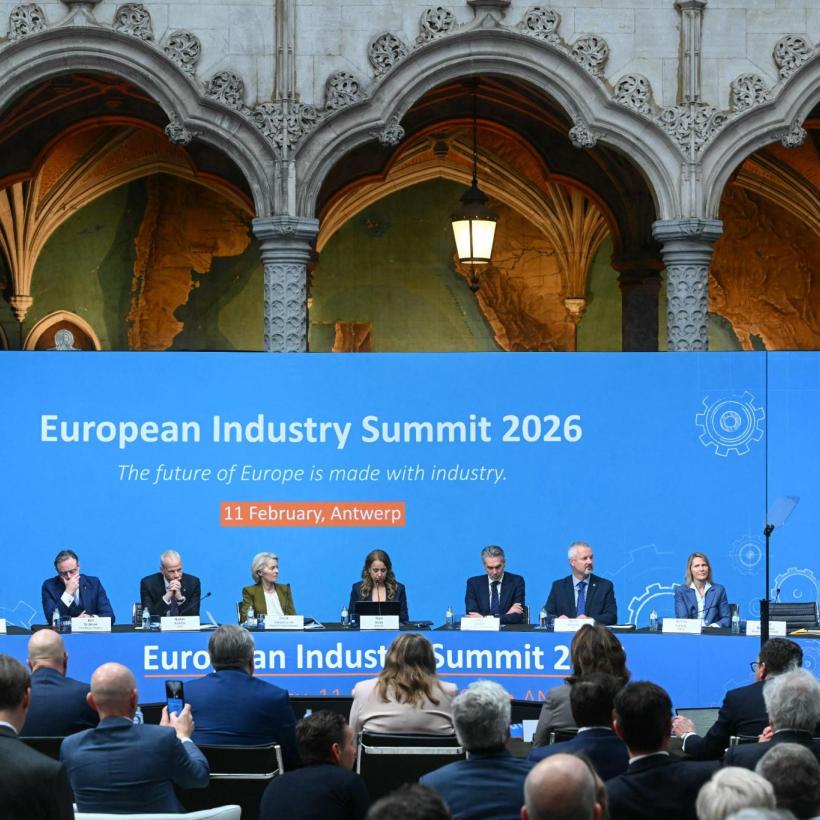
A European industry summit attended by 600 CEOs, an informal summit of heads of state devoted to "competitiveness", a declaration by European Commission president Ursula von der Leyen in Davos, and repeated outings by prime minister Bart De Wever... European leaders and "captains" of industry are using the industrial crisis to impose their agenda, without even a democratic debate.
Shock therapy
Shock therapy designed to reactivate old projects, militarise the economy, sign new blank cheques for multinationals and attack environmental and social regulations. All in order to preserve - and further increase - the profits of multinationals, without the slightest guarantee for the future of industry or our production facilities in Europe. The same people who led us into an industrial deadlock are now posing as saviours. Pyromaniac firefighters, in short.
They intend to mobilise the savings of Europe's citizens as venture capital, rather than touching their dividends. This is the aim of the Europe-wide capital markets union, a project launched almost a decade ago and renamed "Savings and Investment Union" by the European Commission. The aim is to ensure that citizens no longer leave their money in savings accounts, but rather that it feeds the capital markets in the form of risky investments.
Further privatisation and militarisation
Another priority is to promote private pension funds, based on the American model, to the detriment of public pay-as-you-go systems. Workers' savings would thus become a cog in the financial markets. In the event of a crisis, the risk would then lie with them. The example of the United States in 2008 illustrates this: massive losses and pensioners sometimes forced to return to work in old age.
The militarisation of the economy diverts productive capacity, sucks up public resources and directs activity towards confrontation rather than social and climate progress. Making the military effort the driving force behind reindustrialisation will lead either to crisis or to war - and, in both cases, to industrial decline.
It will lead to crisis, because without war there are no sustainable opportunities for an oversized arms industry. It will lead to war, because that is the only way to avoid the collapse of the sector. In both scenarios, military spending comes at the expense of investments that are truly strategic for our industrial future: energy, future technologies and infrastructure.
Corporate handouts won't save our industry
Multinationals are constantly demanding more blank cheques and tax breaks, without tackling structural problems such as high energy costs. Groups like ArcelorMittal, BASF and Volkswagen have reaped billions in profits in recent years, but these gains have hardly been directed towards Europe's industrial future: they have fed dividends or financed investments outside Europe.
The industry of the future will not be built on the standards and wages of the past. Environmental and social rules are now being challenged in the name of "competitiveness". This is the case, for example, with the obligation placed on multinationals to prevent human rights and environmental abuses throughout their value chain - not only amongst direct suppliers, but also amongst more distant subcontractors. Big business has never wanted to abide by these rules, and feels it has an opportunity to get rid of them.
Yet regulations on the environment, safety, wages and working conditions are precisely the levers of industrial development. Many agreements and rules were won after decades of struggle. They aim to prevent chemical disasters and poisoning, and to protect against the exploitation and human trafficking. Recent experience suggests that the problem lies less in an excess of standards than in their lack. One need only recall the PFAS scandal at 3M or the human trafficking case involving subcontractors at Borealis.
To save our industry, we need to take a completely different path: developing an industrial plan based on social and environmental needs, and breaking away from the logic of private profit as our guiding principle.