Nadia Moscufo: "We want workers to play a central role in the party"
Nadia Moscufo went from supermarket cashier to the Federal Parliament. The PTB worker-MP joined the party's Bureau in 2024. This was a necessary step to strengthen the left-wing party, but one that would have surprised the Nadia of the early 2000s...
By Jonathan Lefèvre, Solidaire
Could you tell us a little about your personal journey?
Nadia Moscufo. I am 61 and live in Herstal. My schooling took longer than expected because I repeated the first year of secondary twice and the third year once at the Athénée Royal. At 15 and a half, an unwanted pregnancy led me to have an abortion on December 19, 1979, a period that was all the more difficult because abortion was illegal. I was lucky enough to have the support of my parents, which wasn't a given at the time. I was lucky they were progressive on that regard! (Smiles) This event disrupted my schooling, making me leave school for several weeks, and I started looking for work at the age of 18.
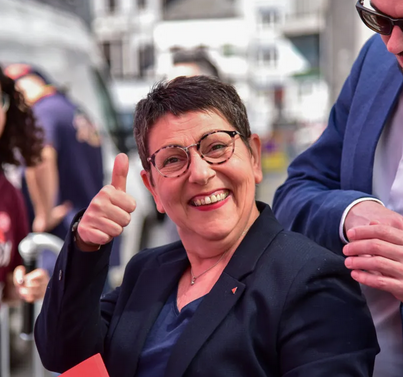
Nadia Moscufo
Worker-MP for the PTB
Your parents were workers too. Did that influence your early career and your involvement in unions?
Nadia Moscufo. My parents, who immigrated from Italy in the 1950s, worked in industry: my father worked in the mines, then at FN Herstal, and my mother too, at the ammunition factory. I first worked in the fish section of a GB supermarket (a chain later bought and replaced by Carrefour, editor's note). I was very proud to take the bus very early in the morning to earn my crust, as we used to say. Even though, for the young woman I was, it wasn't that easy to work with my hands in fish. I still remember the smell and, above all, the department manager, who was really unpleasant. Then, at Choc Discount, as a cashier and stocker. At the register, my chair consisted of two upside-down orange soda crates... I won't even tell you about the comfort... The floor was just covered with metal sheets. My boss used to count how many times I went to the bathroom and would regularly reprimand me for it. That is when the term "poor working conditions" really took on its full meaning for me. A year after I was hired, I became a shop steward. After being made redundant for "reorganization" while raising my young child alone, I was hired by Aldi in 1987, where I stayed for 21 years and became a union representative again after three years. I loved my job, the contact with customers, the teamwork, the satisfaction of a job well done... and at the same time, the lack of respect from management made my stomach turn. When I think that we had to fight for several years just to be able to drink water. We had to pay for it first, even as we were unloading tons of it from the truck to put it on the shelves.
How did you come to meet the PTB?
Nadia Moscufo. My family upbringing had already politicized me a bit, with discussions about the Vietnam War and the Cold War. My encounter with the PTB mainly happened via Médecine pour le Peuple (MPLP) (a network of community medical centers launched by the PTB, editor's note), while I was looking for a doctor. I was intrigued by the presence of MPLP doctors on picket lines. I felt that something was missing in my union work. The party gave me essential knowledge of the history of the labor movement, the different political tendencies, and even the links between colonization and the enrichment of countries. This global and worldwide vision allowed me to connect my personal struggles to society, making me feel less alone. This strengthened my commitment in the face of the magnitude of the task.
You then gradually took on responsibilities within the party. Can you tell us about your activist path, from local councillor to your current role? Nadia Moscufo. I was first a sympathizer. In 2000, I was asked to run in the local elections in order to help elect Johan Vandepaer, an MPLP doctor, as the first elected official in Wallonia, at a time when the PTB was only polling at 2%. I hesitated for a long time, but discussions with party comrades on the need to have elected representatives to demonstrate the capacity for real change, relying on the balance of power built in the street, convinced me. Against all odds, two people were elected! Like everyone else in the room, I first cried. Except that for me, it was out of sadness! I wondered what on earth I was getting myself into! But it passed very quickly... (Laughs)
In 2007, I left Aldi to take on more responsibility within the party. I became a cadre. A party cadre, not a capitalist one... (Laughs) It's an immense source of pride, not for myself, but as a woman from the working class, because society doesn't teach workers how to become cadres. I broke personal barriers, abandoning the idea of being only an executant, and the party enabled me to organize events and to become a trainer on the history of the labor movement.
The 2021 congress marked an important turning point for the PTB, aiming to give a central place to workers. Can you explain this new direction and what is at stake? Nadia Moscufo. The PTB has its origins in the student movement of the late 1960s. Historically, its leaders were mostly intellectuals. The 2021 Congress, after 18 months of internal discussions, adopted a new direction: "We want workers to take a central place in the party at all levels." And in that sentence, every word matters. It's not a question of "giving" them a place, but about ensuring they take it. In 2021, only three workers sat on the National Council (the body that leads the party between two Congresses), out of about fifty members.
The Congress provided a definition for the term "worker": the part of the working class (all people who work for a wage) that doesn't have a higher education degree. Th central role of workers is justified for two major reasons. Firstly, they work in key industrial sectors (energy, etc.) and are essential to changing society and producing wealth. Secondly, they represent 60% of the working class, and their majority must be represented for the PTB to really be the party of this class.
What are the first results of this new direction?
Nadia Moscufo. To implement this orientation, quotas were introduced: 20% of workers on the National Council and in the provincial councils. These quotas are necessary because workers, often conditioned by the capitalist system to be mere executants, would not spontaneously put themselves forward as candidates for leadership positions. The first results are already visible. Most of the comrades concerned are still working, which allows them to witness working conditions at first hand. Like Rosa Terranova, a home cleaning worker and member of the National Council, who is the only one able to describe the violence of the system, which breaks bodies and pushes people to work as long as possible, even when sick. It's an experience that no one else can convey.
This evolution also requires a change in mentality. The goal is not to create a party divided between workers and intellectuals, but to achieve a fusion of skills. Working methods are adapted, with the creation of spaces where fellow workers are in the majority, encouraging them to speak out. Intellectuals can unconsciously intimidate others by their ease of speaking.
Inspiration is also important; workers need role models such as Roberto D'Amico, a federal labor deputy, who reminds late parliamentarians of factory discipline. I am proud to inspire others and to pave a path. It was in this context that I applied to become a member of the party Bureau, something I would never have considered before. This orientation strengthens the party, allowing workers to train, transform and surpass themselves and lead the party alongside their non-worker comrades.
As a worker-MP, how do you feel about Parliament?
Nadia Moscufo. It's fine! (Laughs) The Federal Parliament, with its long corridors, carpets and imposing statues, is a strange place, but it doesn't intimidate me. The political language there is sometimes obscure and even incomprehensible - also for other MPs, by the way... It's a challenge that we face collectively. The PTB strives to maintain a language that is accessible and understandable to everyone, because the capitalist system has no interest in politics being understood.
What is fundamental for us, PTB elected representatives, is to keep in touch with the reality on the ground. I have chosen not to live on the 8,000 euros monthly salary of MPs, and my motivation is not financial, which gives me a freedom that MP's from other parties do not have, trapped in a very comfortable life.
My work as an MP is not limited to Parliament, I have regular contact with union delegates and officials, my neighbours and former colleagues. The complexity of parliamentary political language, often obscure even to politicians, is a challenge. The PTB strives to maintain a language that everyone can understand, because the capitalist system has no interest in politics being understood.
What are the PTB's objectives for the future?
Nadia Moscufo. There are many! (Laughs) But the issue of the central role of workers will remain relevant. We want to expand and strengthen the party's team of worker cadres. We are making progress, but there is still a long way to go. The mechanisms that prevent workers from taking their rightful place are deeply rooted in society, and therefore also in our party. Any relaxation allows spontaneity to take over, and spontaneity excludes workers. Water flows downwards, as we say in our texts from the last Congress.
Together with my comrades Benjamin Pestieau, Deputy Secretary-General, and Denis Pestieau, a member of the National Council, we form a trio responsible for leading this orientation. Together, with the other worker and non-worker cadres, we have achieved significant progress. In addition to strengthening the PTB, this is also necessary for the social struggles to be carried out— for our pensions, our wages, against war and militarization, and so on.