Venezuela - The kidnapping of a president : the power and weakness of Washington
Washington snatched a president from his palace - no, this didn't happen on a movie set, but in a sovereign country. A brutality that betrays both fear and weakness. Fear: they are afraid China is strengthening its control over Latin America. Weakness: those who can no longer impose their will through diplomatic measures, resort to kidnapping as a geopolitical tool.
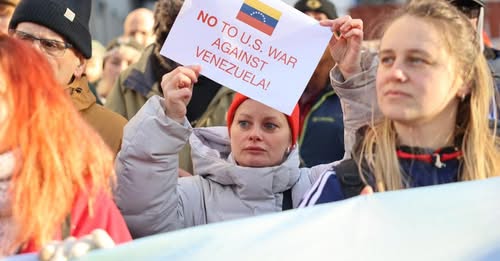
Washington openly kidnapped a president in office and surrendered him to a foreign Court. This is not a Hollywood movie, this happened in a sovereign country. They used bombers, fighters, intelligence aircraft, drones, helicopters and elite units to strike at the heart of Caracas in the middle of the night. This is not even "escalation," it's a return to 19th century gangster imperialism. If diplomacy doesn't get you what you want, use brute force.
The Pentagon euphemistically calls this U.S. operation an "extraction"; it's an abduction. They bombed air defense bases and military installations and used it as a smokescreen. The true reason they were there was to get hold of Nicolás Maduro and his wife, to abduct them, to exhibit them as trophies. And they did all of this without any United Nations mandates.
Anyone normalizing this piracy, is consigning international law to the grave. Because if it's allowed in Venezuela, why shouldn't it be allowed elsewhere? If it becomes "normal" for a superpower to snatch a president from his palace, to transport him across the ocean, the UN Charter will just become a piece of paper. It allows for only one law: the law of the jungle. And in such a world, no one is safe.
The UN Charter prohibits the threat or use of force against the territorial integrity of a member state. That's it. There is no "but," even for superpowers. This is the bedrock. Without it, everything falls apart: States would go to war over any clash, no more rules. We would get a world of failing states, warlords, disconnected superpowers and in a permanent state of violence and chaos.
This is not just an attack on Venezuela. This is an attack on the principle that countries with different systems, interests and cultures can still engage peacefully. Demolishing that principle doesn't lead to "order" but to chaos, to a permanent state of war.
No total invasion, for fear of armed popular militias
This operation was not the classic occupation invasion we know from the previous century. This isn't a Panama with years of occupation, no Grenada, no Dominican Republic. Washington took a different route: a targeted attack with a marked political purpose. That doesn't make it any less serious, quite the contrary.
But it's important to look at what this was NOT: not a large-scale invasion that subjects a country to military rule step by step. It was "something else" - a combination of high-tech violence, the crippling of defense capabilities and then a raid with elite units. The logic behind it is as simple as it is brutal: decapitate the leadership, break the chain of command and obedience, sow panic and force capitulation. This is the way to get the spoils of war without actually getting entangled in a prolonged occupation or guerrilla war.
Why? Because a total invasion carries the risk of a costly war with no way out. Venezuela is not "Syria or Libya." Venezuela is more homogeneous, its state structure is more robust, and they are actually able to function under pressure. Moreover, there is real popular mobilisation: Venezuela's call to expand the Bolivarian militia led to more than eight million citizens arming themselves. This is a powerful deterrent against a ground war.
The fact is that even with the illegal kidnapping of President Maduro, Washington is not controlling Venezuela. The chavists remain in power, and the strategic levers - territory, institutions, resources - are controlled by the official state apparatus. There's no power vacuum into which one can smoothly install a puppet.
Looking at what is happening in the streets, this doesn't look like a country on the brink of collapse. There isn't any fighting between military factions, no rebellion, no blockades, as there were in 2014 and 2017. The most visible mobilisations are expressions of support for chavism. But the uncertainty grows. People are stockpiling food and basic goods; families are trying to protect themselves from what is yet to come. That is often the first social effect of a geopolitical shock: fear, not "liberation."
No credible U.S. marionette available
Washington hoped that Maduro's kidnapping would result in defection, that government members could be pitted against each other, that generals would begin to have doubts, that people would accuse each other of "treason," that things would implode.
But of course that's Washington's Achilles' heel: there is nobody in the country with sufficient mass base AND clout to take over the country on behalf of the U.S. Venezuela is not a country in which to just drop an export product of "regime change." It has much more political, cultural and territorial cohesion than the states that Washington scorched earlier.
Even Trump was afraid to declare a "legitimate opposition leader," even though he had done that as recently as 2019. On the contrary, he belittled opposition leader María Corina Machado who was one of Washington's favorites for years. His judgment was politically significant: according to Trump, Machado "does not have support" and "does not have respect" in her own country. That says it all: Trump knows a U.S. puppet will not be accepted by either the people or the military. So he's trying a different approach: the U.S. will manage the "transition" itself, like a colony.
Oil yes, democracy no
Trump did something after the raid that Western leaders normally try to cover up: he made it clear what it is about. Not about "democracy," not about "human rights," not about "humanitarian needs." It's about power and loot.
At his press conference, Trump was exceedingly clear: he wants access to the world's largest known oil reserves, geopolitical control of the entire region, and he wants to block his rivals, China and Russia, from the entire Western Hemisphere. "Our oil, our backyard, our hemisphere," Trump doesn't mince words. And to secure these interests, control and resources, anything is allowed.
No wonder the Israeli genocide prime minister Benjamin Netanyahu and Argentine far-right leader Javier Milei applauded happily, calling the war violations "historic" and "groundbreaking."
The attack on Venezuela was not about drugs, human rights or democracy, but had only one goal: to prevent Venezuelan oil reserves from slipping out of U.S. control for good and gearing towards the BRICS system. Venezuela has about 303 billion barrels of crude oil. It's the largest proven oil reserve in the world, accounting for about 17 percent of world reserves. The stakes are clear: whoever controls Venezuela controls a strategic reserve in a world where energy still means power. Washington does not necessarily need this oil physically, but definitely wants to prevent these reserves from falling and staying into Chinese hands. Chinese companies today have already claimed billions of barrels of Venezuelan oil, oil that is still in the ground and will not be fully exploited for years. Trump now wants to ensure that future production will be under the control of U.S. corporations.
The Monroe Doctrine: the Western Hemisphere is a hunting ground
The United States actions were predicted in their National Security Strategy of November 2025. They wrote: the Western Hemisphere must again become an exclusive sphere of influence. That document explicitly reactivates the Monroe Doctrine: total control of the Western Hemisphere - from Cape Horn in Patagonia to the Greenland ice sheet. Not because Washington is "concerned," but because it wants to keep its rivals out. Any country that diversifies its relations - trade with China, cooperation with Russia, investment from the South - is suspected, sanctioned, threatened.
The logic might be old, the opponent is new. Whereas the original Monroe Doctrine (1823) was intended to keep out European empires, today's version focuses primarily on China, and to a lesser extent Russia. That means Venezuela inevitably comes into the picture: not only because of its energy and resources, but also because it is a symbol of a region that refuses to be tethered to one power.
At the same time, China's role in the region has grown, through trade and infrastructure investment. Trade in goods between China and Latin America has increased from about $14 billion a year in 2000 to $500 billion in 2024; China, meanwhile, is Latin America's main trading partner.
This means that these countries have more outlets, more choice, and therefore more bargaining power. Beijing increasingly links its trade to collaboration and funding: at the China-CELAC forum, a consultation platform with Latin America and the Caribbean, nearly $10 billion in yuan credit lines were announced. A sign that trade and investment can be organized beyond the dollar. And logistics will follow: a direct shipping route between Guangzhou and Chancay (Peru), a port built by China, should make transportation cheaper and reduce shipping time. Venezuela also counts on China for restoring its oil infrastructure. Just last summer, a Chinese company promised to invest one billion dollars in restarting refineries and developing new sources.
For Washington, that is the problem exactly: each additional economic option in the region reduces U.S. leverage. So the tone hardens, not only towards Venezuela, but also as a warning to others, Mexico, Colombia, Brazil, Cuba, Nicaragua, and even toward Denmark over Greenland. Trump wants everyone in the region to know: "If the U.S. wants it, we'll snatch you out of your palace." That's not just intimidation politics; it's mafia logic on a global scale.
"We will never again be a colony of any empire."
Trump's Venezuela attack also shows his weakness. Of course, the military power of the Pentagon warlords is huge, and right now no country in the world even comes close. Nevertheless, the rise of new economic powers - especially China - puts fear in the heart of Washington. The internal economic and social situation in the U.S. also looks anything but rosy. So Trump increasingly resorts to military force: since taking office a year ago, he has already had seven different countries bombed, in addition to bombing boats in the Caribbean Sea and Pacific Ocean.
The kidnapping of Maduro seems spectacular, but wasn't the succes Washington hoped for. The kidnapping was supposed to cause a "rift," but that has not materialized as yet. The Venezuelan government remains in control, the military remains loyal, the state structure does its job. It is not impossible that Washington will go one step further on the ladder of escalation. If they cannot produce a domestic insurgency, they will continue to try to break everyday life, they might strangle the economy with sanctions and blockades, sabotage critical infrastructure, bomb some more and intervene again to control strategic oil fields.
Meanwhile, Trump maintains sanctions on Venezuelan oil as leverage to force Caracas to make full concessions. To interim president Delcy Rodríguez, he sent a clear message: those who wish to pursue Maduro's course should know that "the same thing could happen to them."
Interim President Rodríguez seems unimpressed. She condemned the U.S. piracy and demanded the immediate release of Nicolás Maduro and his wife Cilia Flores. "There is only one president in this country," she said, "and that is Nicolás Maduro." "We will never again be a colony of any empire," she added.
Europe: silence is complicity
The U.S. also put in their Security Strategy that they want to sabotage any form of regional integration. Washington considers countries that join together and speak with one voice a direct threat to U.S. dominance. That is why it has been trying for years to weaken projects such as the Community of Latin American and Caribbean States (CELAC): by playing countries against each other, applying pressure, and supporting far-right allies, from Argentina to Bolivia.
That same recipe is now being unleashed on Europe - openly, unashamedly, it says so in the new Security text. The stakes are clear: as little European Union as possible, and instead as many bilateral deals as possible with individual countries, each one easier to blackmail, isolate and subjugate. Those who are willing to comply get access and privileges; those who obstruct are punished. To deepen those divisions, far-right forces are increasingly pampered and upgraded - think of the open support for the AfD in Germany.
All of this is simultaneously a symptom of the weakness of the U.S. If you are certain of your hegemony, you do not need to snatch a president out of his palace, you do not need to send vice presidents to far-right meetings in Germany, you do not need to appoint NATO leaders who polish your shoes and call you "daddy." Washington feels that its grip is becoming weaker, because of the rise of China, shifting trade routes, countries diversifying their options. And it's precisely because of that, that they are now moving faster and harder toward spectacle politics and spectacle violence. All of this is meant to shout as loudly as possible, "We're still the ones calling the shots."
Europe cannot hide behind semantics. Talking about "de-escalation" while not naming the crime is not diplomacy; it is complicity. European leaders selectively applying international law - hard on rivals, soft on allies - undermine the only shield that protects smaller countries, including their own. The price is predictable: more blackmail, more sanctions politics, more violence as a method of negotiation. Greenland is the next heralded victim of that subservience.
So only one choice remains: will we normalize piracy as a state doctrine? Or do we draw a line in the sand? Condemn the kidnapping. Defend the sovereignty of countries, even if you don't like their government. Make the UN Charter a boundary again, not a footnote. Because once it is "allowed" in Caracas, the question is not IF it will happen somewhere else, but when.