The car of the future isn't a tank
Restructuring, layoffs, factory closures: the European automotive industry is faltering and shifting its focus to the defence sector. It prioritises profits for its shareholders, the tech crisis, and war, even though prosperity and peace are possible.
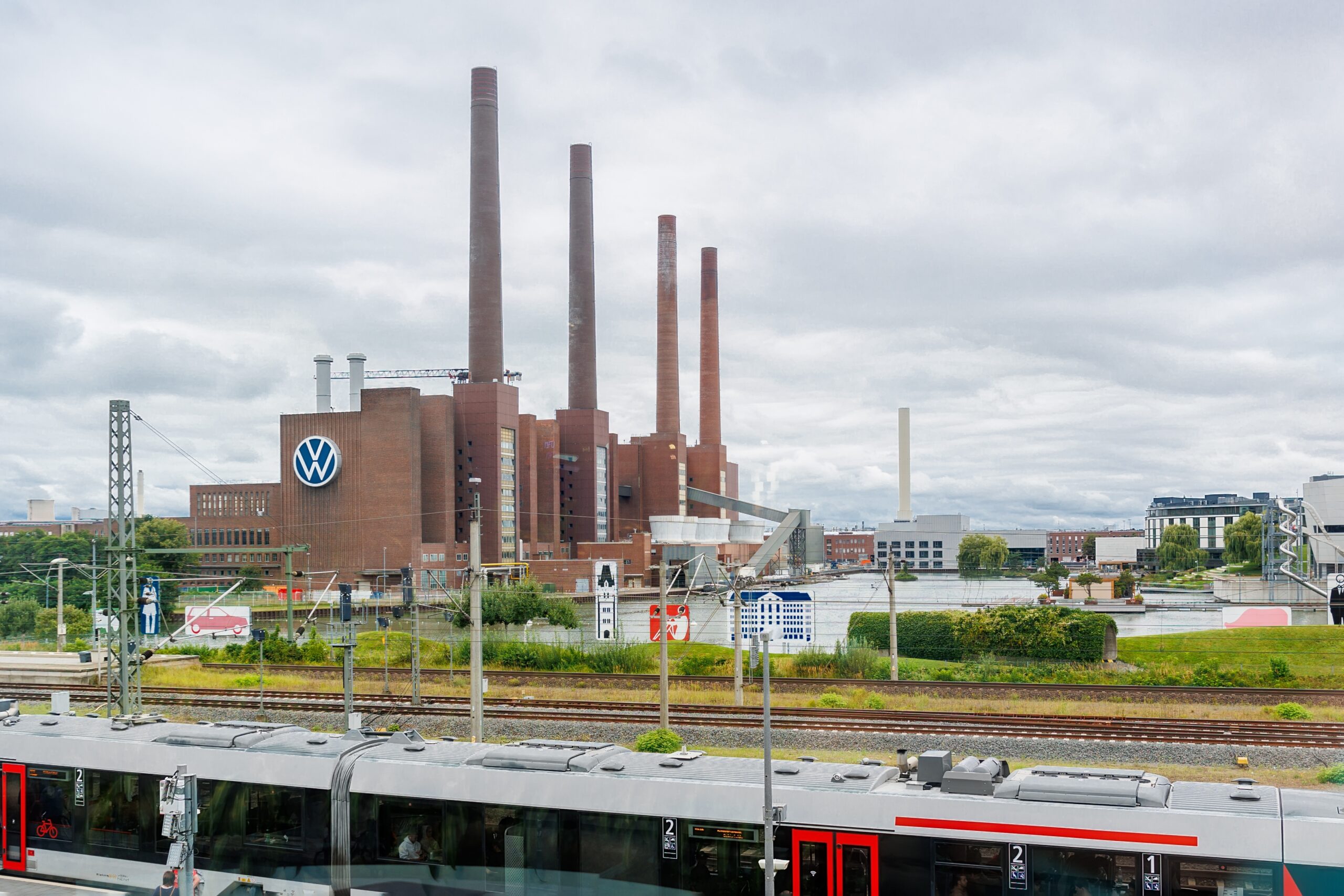
The Volkswagen Group had already announced the elimination of 35,000 jobs at its main automotive brand by 2030 (1). Today, the company is reportedly considering cutting up to 100,000 jobs worldwide and closing four German factories (2). The IG Metall union immediately responded that it would do everything possible to prevent this scenario (3). Once again, the German company is trying to make its workers pay the price for its falling sales - the very workers who have generated the company's wealth. Just as its subsidiary Audi did in Brussels when it closed its state-of-the-art factory located in the country's capital. With this closure, Audi has destroyed jobs, torn families apart, and wiped out expertise. And once again, that is the scenario VW is proposing to its employees.
A crisis across the entire European automotive industry
What is happening with the German giant is not an isolated incident. The entire European industry is affected: Stellantis (4), Renault (5), Mercedes, … BMW, long considered the strongest of the three major German car manufacturers (6), saw its stock price plummet by more than 11% in a single trading session in June 2026, after cutting its margin forecast for the year by more than half (7). In 2025, the German automotive sector cut nearly 50,000 jobs, bringing total employment to its lowest level in 14 years, with approximately 725,000 employees (8).
And this crisis is affecting the entire industrial chain. According to CLEPA, the European Association of Automotive Suppliers, European automotive suppliers have announced 54,000 job cuts in 2024 and 50,000 in 2025, which makes for a total of 104,000 announced job cuts over two years. It is within this supply chain (which is often less visible than the major manufacturers) that the crisis strikes first and hardest (9).
A crisis that does not affect shareholders
The European automotive industry is in the midst of a deep crisis. But first we need to clarify which crisis we are talking about. This is not primarily a crisis of resources. The shareholders of all these companies are rolling in cash. They have been handsomely compensated in recent years. In the post-COVID era, the majority of European car manufacturers have seen a significant increase in their profits. Audi in this way has achieved record operating profits: 7.6 billion euros (10) in 2022 and 6.3 billion euros in 2023 (11). Its parent company, the Volkswagen Group, distributed nearly 11 billion euros in dividends to its shareholders for the 2023 fiscal year
(12). And after these record-breaking years, VW, despite the crisis, is still proposing to pay 2.6 billion euros in dividends for 2025 (13), after having paid 3.2 billion euros for 2024, (14). These dividends are significantly higher than those in the pre-COVID period (2018–2021), (15). Stellantis reported a net profit of 13.4 billion euros in 2021 and 16.8 billion in 2022, (16) and 18.6 billion in 2023. These are record profits in the group's history. In fiscal year 2023 alone, approximately 7.7 billion euros were distributed to shareholders in the form of dividends and share repurchases. Shareholders cashed in during the boom years; now workers are being asked to foot the bill.
A strategy that is falling apart
The European automotive industry (and the German automotive industry in particular) has been built on three pillars for decades: its long-standing expertise in internal combustion engines, its move upmarket towards large SUVs and high-margin models, and the exceptional profitability of the Chinese market.
The internal combustion engine
The German automotive industry has built its strength on a technological lead accumulated over more than a century in the field of the internal combustion engine. In his new book, The Last Days of the Old Normal, Peter Mertens, secretary-general of the PVDA-PTB, aptly summaries what this engine meant for European automotive capitalism: "a protective moat around the European industrial fortress" (17). The image is accurate. The internal combustion engine wasn't just a technical feat; it was a barrier to entry. Its complexity (thousands of parts, specialised subcontracting networks, and accumulated industrial know-how) made it extremely difficult for new competitors to enter the market.
But this complexity was also a steady source of profits. The model didn't end with the sale of the vehicle: regular maintenance, replacement parts, repairs, wear and tear, oil, filters, exhaust systems, gear boxes. An entire after sale industry has emerged around the internal combustion engine.
Electric cars pose a direct threat to this model because they have far fewer moving parts, require less maintenance, and shift the focus of the technology to batteries, software, and electronics. That is why the major European manufacturers have slowed down the transition. Not because they lacked the skills, but because electric vehicles were threatening their traditional source of income. Peter Mertens sums up the situation well: "In the automotive industry, dominant companies such as Volkswagen and BMW have deliberately slowed the transition to electric vehicles. Not because they lacked the expertise, but because the internal combustion engine was their main source of profit. Meanwhile, China has surged ahead of them: thanks to massive public investments in batteries and electrification, this country (despite having entered the automotive industry later than others) quickly caught up with and then surpassed the technological lead that Europe had built up over the course of a century." (18) Here, he describes the tendency of large monopolies (19) such as VW to try to slow down the emergence of a new technology in order to maintain the monopoly profits associated with the existing technology for as long as possible. And this tendency on the part of monopolies to stifle progress in order to protect their monopoly profits is now taking its toll on the European car industry. The International Energy Agency confirms the scale of the technological shift and how far behind European car manufacturers have fallen: in 2025, nearly 55% of new cars sold in China were electric. Chinese automakers account for about 60% of global electric vehicle sales, while European and North American manufacturers each account for about 15% (20).
Large SUVs
European automakers have also maximised their profit margins by focusing on large SUVs (heavy, expensive models with high profit margins) at the expense of small, affordable cars. The share of SUVs in total vehicle sales thus rose from 24% in 2016 to 54% in 2024, and then to 59% in 2025 (21). This strategy improved margins in the short term, but it also drove some households away from the new-car market and delayed the European rollout of simple, affordable, mass-produced electric cars (22).
China
The German model was structurally export-oriented: in 2024, 78.2% of the cars produced in Germany were destined for export; even when counting only those with clearly identified destinations, approximately 45% of all German automobile production was shipped outside the European Union (23). In 2021, China remained the main market for German automotive products and their suppliers, accounting for nearly 30.1 billion euros (24). At the time, it was called German "competitiveness". In 2021, exports of cars manufactured in Germany to China totaled 270,000 units. Today, those exports are plummeting. In 2025, Germany exported only 98,313 vehicles, marking a more than 60% drop in exports to China over the course of a few years.
German car manufacturers have also made substantial profits thanks to their local production in China. They didn't just export to that market: they flooded the market with German-brand vehicles manufactured locally through joint ventures and local production facilities. In 2021, one out of every three cars produced worldwide by German manufacturers was sold in China, and no other foreign country produced as many German cars as China, with 4.3 million units that year (25). For years, this has been one of the cornerstones of German automotive profitability.
But today, the trend is also reversing. Whereas German cars were once synonymous with technology and quality, they are now criticised and sometimes mocked (in automotive testing and the trade press) for lagging behind technologically, particularly in the areas of electric vehicles, batteries, onboard software, and autonomous driving. The market share of German car manufacturers in China fell from about 24% in 2020 to about 15% in the first nine months of 2024 (26). The Chinese market, which for a long time had enabled the German automotive industry to sell far more vehicles than its domestic market could absorb and to generate considerable profits, is thus becoming the exact opposite: no longer a driver of profitability, but rather the area where its technological lag is most evident.
From one dead end to another: slowing down the development of electric vehicles, then looking to the military for a lifeline
Faced with this crisis, a growing segment of the European automotive industry is finding itself trapped in two new dead ends.
The first is to continue slowing the shift to electric vehicles in order to keep internal combustion engines in use for as long as possible. Of course, the industry doesn't put it that way. It speaks of "technological neutrality", "flexibility" and "industrial realism". But in practical terms, ACEA, the European automakers' lobby, asserts that the European CO₂ targets for 2030 and 2035 are no longer achievable and is calling for a more flexible approach, including, in particular, plug-in hybrids, range extenders, hydrogen, and other fuels. In December 2025, the European Commission also presented an automotive package that relaxes the 2035 target: instead of a 100% reduction in exhaust emissions, manufacturers will be required to achieve a 90% reduction; the remaining 10% may be offset by the use of European low-carbon steel, e-fuels, or biofuels (27).
This strategy is a dead end. The prolonged coexistence of two industrial systems (thermal and electrical) is very costly. It fragments investment and slows down the realisation of economies of scale in batteries, electric vehicle platforms, software, and supply chains. While Europe dithers, China is accelerating its technological progress.
The second dead end is that of the militarisation of the means of production: several manufacturers are now looking to the militarisation of their production as a source of growth. The trend, which had already begun earlier, accelerated significantly in 2025 and 2026. And this movement is encouraged by politicians. Katherina Reiche, the German Minister of Economic Affairs, stated: "The automotive industry possesses expertise that is urgently needed today in the defence sector." She adds: “"ightweight construction, modern propulsion technologies, sensors, software, and high-precision quality assurance: all of this can be specifically applied to military applications" (28).
Daimler Truck has launched the Daimler Truck Defence brand, with a goal of generating 1 billion euros in defence-related revenue by 2028 and investing several hundred million euros (29).
INEOS Automotive, SMT Defence, and NMS UK have formed "Team Grenadier" to offer vehicles based on the Grenadier platform to the British Ministry of Defence (30).
Mercedes-Benz has also signed a memorandum of understanding with the German startup Tytan Technologies to develop mobile anti-drone systems, specifically based on the G-Class and Sprinter models. The company has not yet provided a specific timeline or investment amount (31).
Volkswagen is reportedly in talks with the Israeli company Rafael Advanced Defense Systems to convert its Osnabrück plant to produce components for the Iron Dome missile defence system. The plan would be to produce support equipment such as transport trucks, launchers, or generators (32).
Renault and Thales unveiled the 4 TROOP, a tactical vehicle based on a Renault civilian platform, and announced a partnership to mass-produce the TOUTATIS remotely operated munition, with an announced production capacity of 1,000 units per month starting in the first year (33). And that's not all: the newspaper L’Humanité explains that "under pressure from Emmanuel Macron and the French government, Renault (…), will focus on the industrial-scale production of military drones" (34).
In January 2026, Renault confirmed its commitment to the Chorus project, in partnership with Turgis Gaillard. The Renault plant in Le Mans is set to assemble these military drones, with a production capacity of up to 600 units per month within less than a year (35). This is a contract that could "earn it up to 1 billion euros over 10 years to produce up to thousands of long-range, multi-purpose, remotely piloted drones - 'for attack or surveillance, at an extremely competitive price'", according to the official project description. "This drone, with a wingspan of ten meters (…), will be built at Renault's factories", according to the sponsor, the Directorate General of Armaments (DGA) (36).
The CGT union at the Renault Group immediately reacted negatively to this development. In January 2026, it said: "If Renault were to diversify, it could not do so at the expense of its ethics or by becoming involved in a war-like mindset. Renault's core business, as an car manufacturer, remains first and foremost the design and production of vehicles that meet people's needs" (37)
. And just recently, following the Renault-Thales announcements, it once again criticised the group's "military focus": "The CGT-Renault opposes the company's shift towards the military sector. Profiting from the push to war will never benefit workers. (…) Discussions in offices and workshops show that many employees reject this direction, because they joined Renault to build cars, not weapons." (38)
This militarisation is portrayed as mere industrial diversification. But socially and economically, it is a dead end. The money, engineering expertise, production capacity, and supply chains that go towards weapons are not being directed towards batteries, software, autonomous driving, affordable small electric cars, or the power grid needed for the transition. In the short term, this headlong rush may lead to contracts. In the long term, this could further widen the gap between the European automotive industry and the cars of the future.
Above all, the war economy creates its own logic. As we have already written: "Making militarisation the driving force behind reindustrialisation will lead either to war or to a crisis, and in either case, to industrial decline. To crisis, because without war, there are no sustainable markets. To war, because it becomes the only way to avert a crisis in the sector. And ultimately, to the decline of our entire industry, because military spending comes at the expense of other strategic investments in our industry" (39). We urgently need to adopt a completely different approach
The current crisis is not an inevitable consequence of technology. The crisis did not come out of the blue. It is the result of capitalist logic in the age of monopolies: major manufacturers choose to stick with outdated technology in order to preserve their monopoly profits for as long as possible. Now they want to make workers pay for the consequences of those choices. And instead of investing heavily in the car of the future, a growing portion of the industry is turning towards militarisation.
We need to adopt a different approach
First, dividends and share buybacks from profitable years must be put to use. When a company has distributed billions to its shareholders, it cannot then pass the bill on to its workers. A one-time tax should be levied on dividends and share buybacks paid out by major automotive groups in recent years. These resources must be directed towards research and development, the transition to electric and autonomous vehicles, worker training, and job retention. Not a single euro of public aid should go to companies that lay off workers, close factories, or pay dividends.
Next, we need a genuine European industrial plan for the electrification of transportation: electric public transportation (buses, trams, metros, trains) and affordable electric cars instead of prioritising premium models priced at over 70,000 euros. We need to produce electric vehicles that are smaller, simpler, easier to repair, more material-efficient, and affordable. We should develop electric buses, bicycles, and motorcycles.
We must also invest heavily in the physical infrastructure needed for electrification: low-carbon electricity generation, power grids, charging stations, batteries, recycling, public transportation, and democratic mobility planning. Without abundant, clean, and affordable energy, electrification will remain fragile and unequal. The transition risks only becoming accessible to those who can afford it, while workers are excluded from the new-car market or are forced to keep aging vehicles.
Finally, we must not allow the automotive crisis to be used to push the industry towards a war economy. The skills of automotive workers are invaluable: metallurgy, electronics, software, batteries, assembly, logistics, maintenance. They must be used to produce goods that benefit the population, not to trap Europe in a cycle of militarisation, constant rearmament, and confrontation.
The European automotive industry has a future. But not by leaving the sector in the hands of those who failed to adapt to industrial change or in the hands of those who want to save the sector by militarising it. The issue is not about safeguarding shareholders' profit margins. We must prevent automobile factories turning into war workshops. We must save jobs, expertise, industrial sites, and the ability to produce in new ways. We must ensure that our industry serves the needs of the people and society.
- https://annualreport2024.volkswagen-group.com/group-management-report/volkswagen-ag/annual-result.html
- https://www.zonebourse.com/actualite-bourse/le-pdg-de-volkswagen-envisage-de-supprimer-jusqu-a-100-000-emplois-dans-les-prochaines-annees-selon-ce7f5fd9db8ef126
- https://guideautoweb.com/articles/82444/volkswagen-pourrait-supprimer-jusqu-a-100-000-emplois-et-se-scinder-selon-un-media-allemand/
- https://motorsactu.com/stellantis-en-crise-arret-de-production-dans-7-usines-en-europe-et-ventes-en-chute-libre/
- https://motorsactu.com/renault-face-a-la-tempete-3-000-emplois-menaces-dans-un-plan-de-survie-historique/
- VW, Mercedes et BMW
- https://www.lecho.be/entreprises/auto/volkswagen-envisagerait-de-supprimer-jusqu-a-100-000-emplois/10676894.html
- https://www.autoactu.com/actualites/automobile-les-importations-chinoises-depassent-les-exportations-europeennes-en-2025
- Source : CLEPA, Data Digest #24, 14 janvier 2026, https://www.clepa.eu/insights-updates/data-digests/structural-pressures-on-europes-suppliers-policy-delivery-is-key/
- https://www.audi-press.be/2022-fiscal-year-record-operating-profit-for-audi
- https://www.audi-mediacenter.com/en/press-releases/after-a-solid-fiscal-year-2023-audi-strengthens-and-expands-its-product-portfolio-15957
- Rapport annuel 2023, Volkswagen Group, p. 366
- Volkswagen Group Annual Report 2025, https://annualreport2025.volkswagen-group.com/ ; Volkswagen dividend 2025, https://annualreport2025.volkswagen-group.com/group-management-report/volkswagen-ag/dividend.html
- Volkswagen Group Annual Report 2024, https://annualreport2024.volkswagen-group.com/ ; Volkswagen dividend 2024, https://annualreport2024.volkswagen-group.com/group-management-report/shares-and-bonds/dividend.html
- https://annualreport2018.volkswagenag.com/group-management-report/shares-and-bonds/dividend.html
- https://www.media.stellantis.com/uk-en/corporate/press/stellantis-delivers-record-full-year-2022-results-global-bev-sales-up-41-progressing-fast-on-dare-forward-2030-execution
- Peter Mertens, Les Derniers jours de l’ancien monde, Agone, 2026, à paraître. Traduction de travail à partir de l’édition néerlandaise De laatste dagen van het oude normaal, p 40, EPO, 2026.
- Peter Mertens, Les Derniers jours de l’ancien monde, Agone, 2026, à paraître. Traduction de travail à partir de l’édition néerlandaise De laatste dagen van het oude normaal, p 41, EPO, 2026.
- C’est un grand groupe, ou un petit nombre de grands groupes, qui concentre tellement de capital, de production et de pouvoir économique qu’il peut dominer un secteur, influencer les prix, imposer des normes, orienter les choix technologiques et peser sur les décisions politiques.
- Sources : IEA, Global EV Outlook 2026, https://www.iea.org/reports/global-ev-outlook-2026/trends-in-electric-cars ; IEA, Global EV Outlook 2026 Executive Summary, https://www.iea.org/reports/global-ev-outlook-2026/executive-summary
- Jato Dynamics : https://www.larmor.info/suv-les-plus-vendus-en-europe-en-2025-classement-et-tendances/
- JATO Dynamics, 27 janvier 2025, https://www.jato.com/resources/media-and-press-releases/european-new-car-market-growth-in-2024-driven-by-hybrids-and-chinese-brands.
- https://www.vda.de/en/news/facts-and-figures/annual-figures/exports
- https://www.vda.de/en/news/articles/china-Partner-and-competitor-in-the-automotive-industry
- https://www.vda.de/en/news/articles/china-Partner-and-competitor-in-the-automotive-industry
- https://merics.org/en/comment/german-carmakers-are-placing-risky-bet-china
- https://www.acea.auto/news/2030-2035-targets-for-cars-and-vans-not-achievable-europe-needs-smarter-regulatory-path-and-distinct-approach/
- Anne Sophie Feil, « Zivile Industrie soll Rüstung stärken », ZDFheute, 2 décembre 2025. URL : https://www.zdfheute.de/wirtschaft/ruestung-industrie-synergie-100.html
- Daimler Truck, 2026, https://www.daimlertruck.com/en/newsroom/pressrelease/daimler-truck-expands-global-defence-business-53506055
- INEOS Automotive, 17 juin 2026, https://media.ineosgrenadier.com/en/news-articles/ineos-automotive-joins-forces-with-smt-defence-and-nms-uk-to-deliver-for-the-ministry-of-defence.html
- Mercedes-Benz Group, 11 juin 2026, https://group.mercedes-benz.com/unternehmen/news/mou-tytan.html ; https://www.welt.de/newsticker/dpa_nt/infoline_nt/wirtschaft_nt/article6a299f425f783159b22afe11/mercedes-will-mit-drohnen-start-up-tytan-kooperieren.html
- https://www.ft.com/content/1e41e6db-792f-4f60-b567-adb6458fb072
- Renault Group 4 TROOP, 15 juin 2026, https://media.renaultgroup.com/eurosatory-2026-renault-group-et-thales-devoilent-4-troop-le-vehicule-tactique-innovant-dedie-aux-futurs-engagements-des-forces-terrestres/?lang=fra // Renault Group-Thales TOUTATIS, 16 juin 2026, https://media.renaultgroup.com/renault-group-et-thales-nouent-un-partenariat-strategique-pour-developper-une-filiere-drone-souveraine-en-france/?lang=fra
- https://www.humanite.fr/monde/armement/pourquoi-renault-est-requisitionne-dans-la-fabrication-de-drones-de-combat
- https://media.renaultgroup.com/info-presse-drones/?lang=fra
- https://www.humanite.fr/monde/armement/pourquoi-renault-est-requisitionne-dans-la-fabrication-de-drones-de-combat
- https://www.humanite.fr/monde/armement/pourquoi-renault-est-requisitionne-dans-la-fabrication-de-drones-de-combat
- https://journalauto.com/constructeurs/la-diversification-de-renault-dans-la-defense-suscite-la-colere-de-la-cgt/
- https://lavamedia.be/fr/pourquoi-militariser-leconomie-europeenne-ne-va-pas-sauver-notre-industrie/ et video Fakto https://www.youtube.com/watch?v=oeY5VsFQTmI&t=9s