
The storm has only just begun
Across Europe, welfare is being cut to fund warfare, and a storm of resistance is rising. Can the fight against austerity and the fight against war become one?
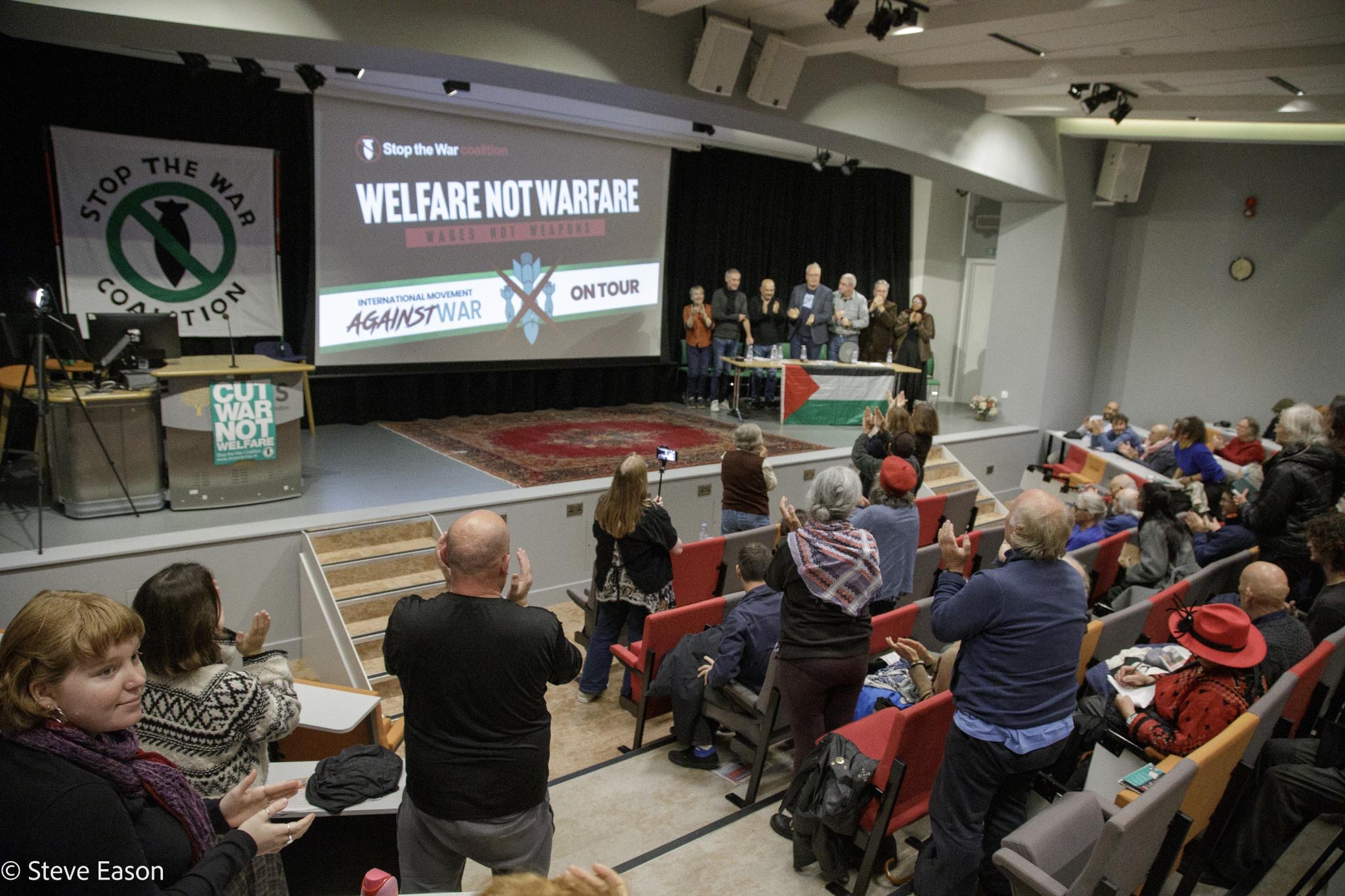
Speech at the Welfare, Not Warfare rally in London, Friday 23 October 2026
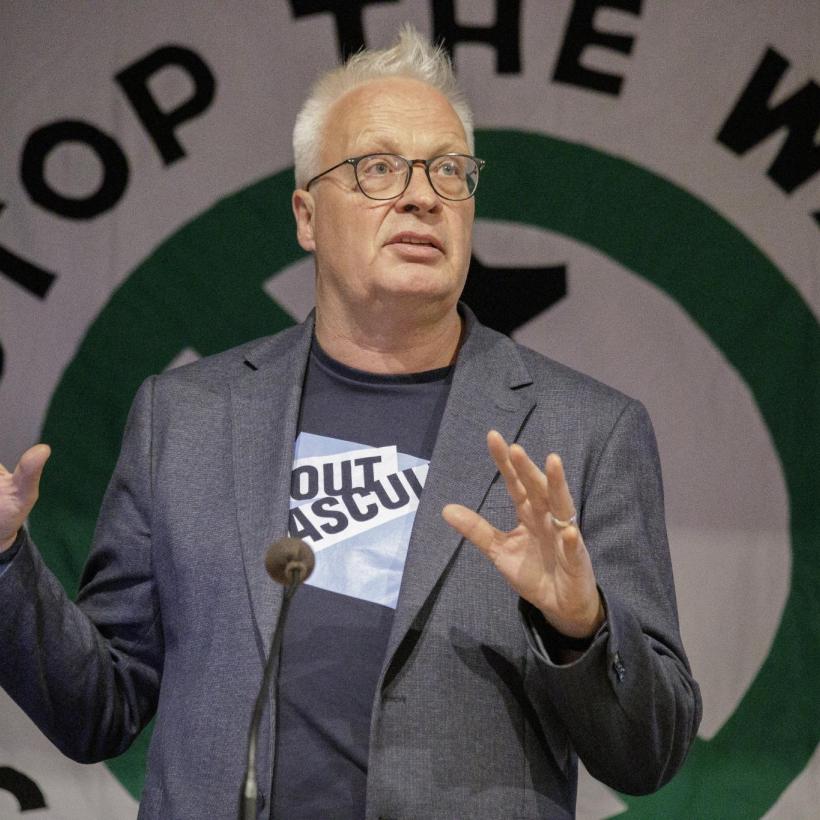
The BBC announced the first storm of the season this week. A storm that has even been given a name: Austen.
But that is not the only storm. There is another one.
A storm that does not appear on weather maps, that respects no national borders, and that spreads from one country to another.
And that storm also has a name: class struggle.
Some people were afraid that there would be no more major social movements. That people would simply accept austerity, militarisation and the dismantling of their social rights. That the younger generation would simply accept a future that is becoming increasingly uncertain.
Dear friends and comrades, all we have to do is look around us.
In Belgium, the trade unions have been mobilising for more than a year against attacks on pensions and social security. On 9 October, another 50,000 people took to the streets, and a major national mobilisation is already planned for the end of November.
In Spain, tens of thousands of people took to the streets after Maricarmen Abascal, an 87-year-old woman, was evicted from the home where she had lived for more than seventy years. Her story became a symbol of the housing crisis and sparked a movement of tenants, young people and ordinary people demanding the right to affordable housing.
In Albania, tens of thousands of students and young people are rising up against corruption, rising education costs, repression and a future without prospects. While luxury resorts and property developments are popping up all around them, young people can barely afford a home of their own.
In Ireland, more than 300,000 teachers, nurses, doctors and civil servants walked off the job in the biggest strike in almost twenty years.
In Italy, more than 100,000 people gathered in Rome. They were demanding higher wages and pensions, better healthcare and education, and an end to militarisation. And the trade unions have already announced another general strike, on 20 November.
And then there is France! On 13 October, 480,000 people took to the streets. Four days later, they were 800,000. High school students, university students, workers, pensioners and trade unionists, alongside the Gilets Jaunes and all sorts of social movements. An entire generation that refuses to let them steal their future.
A new, continent-wide wave of social resistance is ongoing.
And yet, it is rarely recognised as a single, interconnected movement.
A strike in Ireland, a student demonstration in Albania, an occupied square in Madrid, hundreds of thousands of people on the streets of France: all are viewed in isolation, as if these movements had nothing to do with one another.
Precisely the opposite is true: this is a continent-wide storm.
So no, the problem is not that there are no mass movements. The problem is that we still fail to fully understand how big these movements are, how widespread the resistance has become, and how many people in different countries are actually fighting the same struggle.
A struggle against a gigantic theft.
What is being prepared today is no ordinary round of austerity.
It is a fundamental redistribution of society’s wealth.
Away from social security, public services and the needs of the population, and towards the arms industry, military institutions and major capital groups.
We are all told that we have to make sacrifices. There is no money, we are told; we must lower our expectations. We hear this in Belgium, the Netherlands, Germany, France and Great Britain. But apparently, there is one ministry that never has to make sacrifices: the Ministry of Defence.
In Belgium, every ministry has to tighten its belt, except the Ministry of Defence. That ministry is getting an additional 34 billion euros. We decided to request a copy of the Ministry of Defence’s shopping list.
And what is on that list? Half of it consists not of defensive equipment, but of equipment for military interventions: killer drones, F-35s, frigates and armoured combat vehicles to intervene in the Sahel and the Congo and secure access to minerals and raw materials.
They are not building a European defence force. They are building a European imperialist army, paid for with money we urgently need for our schools, our healthcare and our pensions.
And that is the heart of the matter. This is not just about how much money is being spent, but also about what kind of society they want to build.
In the United States, we can see where this model leads: enormous military budgets, while millions of people lack adequate access to affordable healthcare. A society where a single hospital stay or a serious illness can financially ruin an entire family.
Is that the future they have in mind for Europe? A continent with more fighter jets, but less fire fighters? More soldiers, but less teachers? More barracks, but less schools?
This is a fundamental choice about what kind of society we want. And more and more people are beginning to see what is really at stake.
In France, hundreds of thousands of young people are mobilising around one of the most constructive demands imaginable: they want better education. They want their talents, their creativity and their energy to be put to work improving society, rather than being lost to an industry of destruction and war.
Isn’t that an incredibly positive message?
And how are these young people answered? With batons, tear gas, military deployments and bans on demonstrations. Militarisation abroad always goes hand in hand with militarisation at home. Always.
We can see this in Belgium too. After the student protests in Brussels, Defence Minister Theo Francken said that young people needed boot camps and military re-education. One of the young student leaders in Brussels, Louise Mandjombe, who is just seventeen years old, gave him a brilliant response:
“We already have places where we can educate young people. But they are not called boot camps; they are called schools. And maybe you should start investing in them”
I think that is an amazing response. Because in just a few sentences, she captures the fundamental contradiction of our times. A younger generation demanding education, opportunities and a future, confronted by a political elite that increasingly thinks in terms of weapons, barracks and military discipline.
And that brings us to what I believe is the great strategic question facing us in the period ahead.
The question is not whether there will be more major social movements. They are already here, and they will continue to grow. The big question is whether the movement against austerity will merge with the movement against war and militarisation.
So far, these two movements have often developed side by side. On one side are the trade unions, workers, young people and pensioners fighting against the dismantling of social security and public services. On the other are the peace movement, young people resisting compulsory military service, and those who refuse to be drawn into the new arms race.
But these two movements are not fighting separate battles. They are confronting the same choices, the same economic interests and the same system that puts profit and military power above the needs of the population.
Yet in more and more places, these movements are coming together. Welfare, Not Warfare is where the two movements meet, and that is why this initiative is so essential.
To show what’s happening all over Europe I would like to cite a trustworthy organization: “Fox News”.
A Fox News “digital investigation” discovered, and I quote, “a growing number of communist, socialist and other hard left organizations are answering the call for a coordinated European youth strike on nov 20th”.
Friends, I might be mistaken, but I think they are getting somewhat nervous.
Because, yes, on 20 November, school pupils and students across Europe will go on strike, and that same weekend, the trade unions will be mobilising once again.
That’s why Fox News is scared. That’s why our defense minister is scared. That’s why they try to relaunch the red scare.
Comrades,
History does not move forward in a straight line. It has its highs and its lows, its periods of stagnation and its moments of sudden change. Those who think in linear terms assume that whatever is big and powerful today will always remain big and powerful, and that whatever is small will always remain small.
But those who understand that we are only at the beginning of a storm also know that what seems all-powerful today can disappear tomorrow, and that what seems small today can grow into a major force at breathtaking speed.
The disadvantage of a storm is that it can blow in any direction. But its advantage is that it can also suddenly awaken many people who have been asleep for years.
In periods of stagnation, people learn slowly. In periods of struggle, many people can learn very quickly. People who thought they were standing alone can find one another. People can discover how much they have in common, and how much power they can build together.
We are seeing that today, from Rome to Madrid, from Brussels to Dublin, from Paris to London.
It is up to us, comrades, to connect these movements and give the storm a direction. Not change capitalism, not to give imperialism a different face, but to change everything.
To change everything and build socialism.
Because the storm is not over.
The storm has only just begun.


