"Optimism is not primarily a 'state' but a struggle"
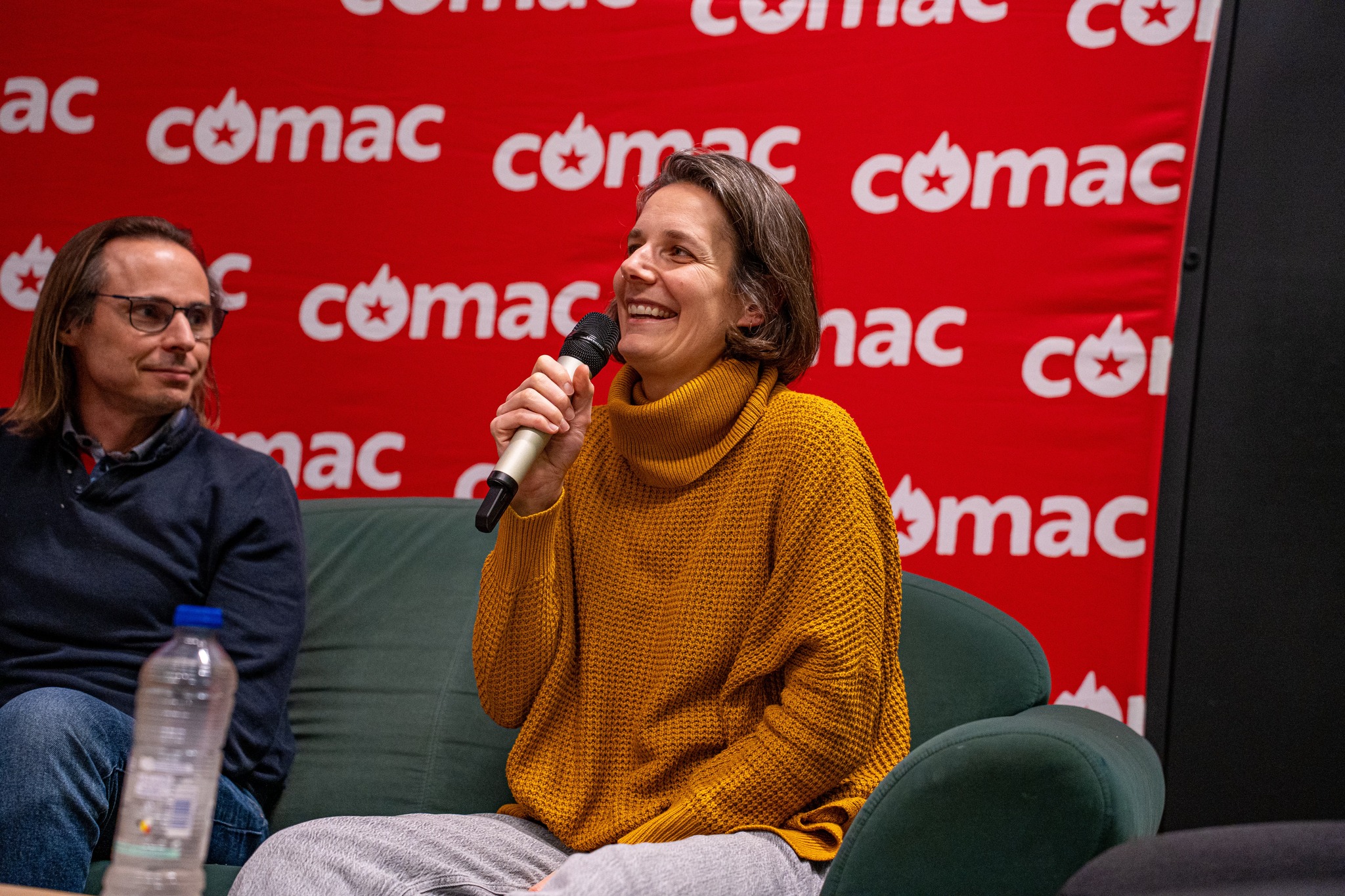
Are you an optimist? That's the question Anne Delespaul and Benjamin Pestieau - member of the direction of PVDA-PTB, were asked during the Karl Marx School organized by Comac, the PTB's student movement. "Optimism is not primarily a 'state' but a struggle,". Benjamin comes back to some of the points made.
Optimism is a struggle
What is the alternative to optimism? Some might say: "I'm not an optimist, I'm a realist." But what exactly does this word mean? And above all, where does it lead, in concrete terms, in terms of action and ambition? Often, this so-called "realism" is not a cold description of the world: it's a refuge. It serves as an explanation for inaction, a justification for fatalism and powerlessness — the idea that, no matter what we do, nothing will fundamentally change; the feeling of being condemned to endure a system that exploits, oppresses and destroys both humans and nature.
This fatalism does not come out of nowhere: it is introduced into society and into people's minds, because it serves certain interests. It causes people to withdraw, isolates them and narrows their horizons. It lowers their expectations to the point of rendering them harmless: "I'll just try to change what's around me." Then, almost mechanically, it turns big questions into impossibilities: changing society as a whole? Impossible, say the "realists". And what they call realism becomes above all a pessimism of ambition — a way of making peace with the existing order by declaring it unassailable.
Optimism and pessimism are not neutral feelings. One fuels the emancipation movement; the other objectively serves the interests of those in power, because it leads to inaction. It is in the interest of any ruling class to make those who challenge its power doubt their own strength. For them, pessimism from below is a guarantee: the certainty that their domination will continue. They therefore actively strive to ensure that pessimism and a sense of powerlessness reign at the bottom, so that they can continue to reign at the top.
Optimism, then, is first and foremost a struggle. A fight against the ideas that are put in place to disarm us.
No human work is eternal
This struggle is not new. A constant feature of exploitative societies is to make people believe that the existing order is natural, inevitable and eternal. Some regimes have invoked divine grace to justify their eternity: Louis XIV claimed to be king by divine right. But the mechanism is always the same: to make people believe that the time of domination will not change, that protesting is pointless — or even that protesting will further reinforce domination — and that the future will be nothing more than a repetition of the present.
The probability that tomorrow will resemble today is obviously high. Yet history teaches us that some tomorrows are very different from yesterday. The most established systems eventually collapse under the weight of their contradictions and class struggle. Marx explains: "Men make their own history, but they do not make it as they please (...) but under circumstances existing already, given and transmitted from the past." (Karl Marx, The Eighteenth Brumaire of Louis Bonaparte, 1852). In other words: nothing is predetermined, but nothing happens outside power struggle either. This is precisely why optimism is a struggle.
Dominate through division, competition, and isolation
To produce pessimism and resignation, the ruling classes constantly work to divide, compete and isolate. In capitalist society, power lies at two poles: the pole of capital and the pole of numbers. Capital dominates thanks to the concentrated means it can activate: economy, media, institutions, culture, repression.
The pole of numbers, on the other hand, consists of the working class and all the strata which, in one way or another, come into conflict with the pole of capital: self-employed workers who are being strangled, farmers, young people, democrats and many others. But there is nothing automatic about this "number". It requires meticulous, slow and constant work to build it on two levels: quantitative (being as numerous as possible) and qualitative (degree of organisation and awareness). And those on the other side understand this well: they seek to create a thousand hierarchies between us, to make us compete with each other, to isolate us. The goal is always the same: to transform a potentially powerful social majority that is aware of its interests into a juxtaposition of weak, isolated, divided individuals — and sometimes pitted against each other.
The ultimate dream of capitalism is to rule over a mass of individuals. In its early days, factories hired workers under very different wage and working conditions, with systematic competition between categories. Marx put it bluntly: "Capital is concentrated social force, while the workman has only to dispose of his working force. (...) The only social power of the workmen is their number. The force of numbers, however is broken by disunion." (Karl Marx, Instructions for the delegates of the Provisional General Council of the IWA, August 1866.)
This division takes on new forms every day. Starting in school: failure or mistakes too often become sources of exclusion and relegation, rather than opportunities for learning, reinforcement or mutual support. Success is easily built against others: I am first, therefore I am better than. Rankings, exams and hierarchies perpetuate this logic. The same mechanism can be found in the workplace, where mistakes mean punishment, demotion or dismissal. And capitalism also mobilises racism, sexism and all forms of oppression available to create a society where workers, and the population at large, are as divided, isolated and distrustful as possible.
In the United States, we are also seeing a crackdown on leaders of the movement against genocide in Gaza, starting with leaders of foreign nationality. This is not a minor detail: it is a message sent to all those who would like to mobilise, a warning aimed at isolating, intimidating and dividing them.
Internationally, the same logic appears in imperialist aggression. Colonial nostalgia is increasingly on display. US Secretary of State Marco Rubio said at the Munich Security Conference (February 2026): "It is a path we have walked together before and hope to walk together again. For five centuries, before the end of the Second World War, the West had been expanding – its missionaries, its pilgrims, its soldiers, its explorers pouring out from its shores to cross oceans, settle new continents, build vast empires extending out across the globe." This kind of narrative is not just a simple phrase: it is a way of legitimising the idea that dominating the world is a "natural" vocation for the West, and that this "spirit" of conquest must be rediscovered.
But the more a regime — and the ruling classes of a system — are forced to rule through repression, or through war on the international stage, the more it is an admission of weakness. It is an admission that they can no longer obtain consent by "normal" means, an admission that they can no longer contain dissent and must use brutal means to perpetuate their domination. We see authoritarianism rising and imperialism hardening everywhere. This does not come out of nowhere: it is also the contradiction of a capitalism that is no longer able to reconcile its thirst for profit, global competition, climate chaos and popular resistance — in the Global South, but also at home, against social and ecological regression. Capitalism is no longer able to control all the contradictions it creates, nor the struggles that these contradictions give rise to. It is therefore resorting to more aggressive means. What appears to be a sign of strength is in fact a sign of fragility.
The ingredients of optimism
Optimism is a battle against those who would have us be pessimistic, powerless, inactive. It is a battle waged without naivety: billionaires and their ideologues are prepared to do anything to preserve exploitation and domination. The future that those who pull the strings under capitalism have in store for us is not a positive one, either for us or for future generations. But this aggressiveness is also a sign of nervousness: it reveals the inability of the elites to sustainably govern a system in crisis. Being optimistic does not mean believing that victory is certain. It means considering that history remains open.
To build optimism, several ingredients must be brought together.
First, action. Optimism cannot be built through inaction, as a spectator. Nor can it be built by commenting on reality, but by trying to transform it. Action does not guarantee victory, but it breaks the cycle of powerlessness. It restores movement where others would have us remain frozen. And every struggle that achieves even a partial victory transforms the consciousness of those who participate in it: we learn that we can make a difference, that we can shift boundaries, that we are not condemned to suffer.
This energy is fuelled by what we do ourselves, but also by what others do. It comes from those who stand up when those above would like to see them bow their heads: the working class of Minneapolis (USA) who, in minus 30 degrees Celsius, went on strike to drive out the ICE troops sent by Trump to terrorise the city and hunt down foreigners; those who led more than 13 national actions last year in Belgium and forced the Arizona government to back down on their pension reform and attacks on democratic rights; those who are struggling in very harsh conditions — such as the Palestinian people facing genocide, or the Cuban people against the suffocation imposed by the United States. It also comes from historical inspiration, such as the anti-fascist resistance: proof that even when the night seems darkest, we can organise, hold fast and turn the tide. These examples serve as beacons: they do not replace our path, but they remind us that a path exists, even if it is sometimes difficult to find.
Then there is the collective. Any human endeavour of value is a collective endeavour, and this also applies to the struggle. The struggle is too complex to be undertaken alone. In moments of victory as well as in difficult times, we need to build a collective — because it is the collective that transforms "numbers" into strength. The collective allows us to pool our experiences, learn from our failures, and overcome individual discouragement. It transforms a collection of scattered experiences into organised strength. It is what prevents each of us from being left to our own devices, what allows us to hold on when things get rough, and to grow when we win.
The ruling classes understand this well: they abhor the idea of any class, the youth or a people being organised. They prefer a thousand isolated individuals to a collective force that learns, disciplines itself and passes on its experiences and knowledge. That is why they encourage competition, mistrust and every man for himself: so that solidarity never becomes a force to be reckoned with.
This collective is built around common goals and values such as solidarity, honesty, pride, modesty, respect for work and a love of science. On this basis, failure becomes a source of empowerment, and the qualities of others become a source of learning. And this collective reflex can be found everywhere: in trade union delegations, in groups of colleagues, in associations, in student circles; in celebrations and in action; in solidarity and mutual aid; in collective study groups where people prepare for exams together; in all the occasions where people meet and learn to trust each other. The collective is what transforms the warmth of a moment into continuity, and anger into the ability to really make a difference.
Finally, a framework for analysis and a method for action. Optimism is built on a deep understanding of the world and how it is changing. In the current period, we need study and theoretical and practical tools to guide our action. Marxism is essential if we are to understand the contradictions of the moment and act without losing focus. For the first time, it provided tools for interpreting the real movement of history: the development of productive forces — techniques, technologies, knowledge — and class struggle. In other words: understanding what is changing in the world, and understanding who is at odds with whom in this change.
And the world is changing rapidly at the moment. As Peter Mertens says, it is undergoing a shift: the emergence of the Global South, technological breakthroughs, climate tipping points, the relative decline of the imperialist camp coupled with a resurgence of its aggressiveness – both internally and in international relations – the resurgence of fascism, but also the growing integration of struggles at the global level against common enemies. In this acceleration, study and method are not a luxury: they are landmarks, compasses that prevent us from going round in circles or being headless chickens. Without a map, we confuse ephemeral agitation with the patient construction of a course capable of producing great change.
This analytical framework allows us to link our daily struggles for immediate improvements to the broader struggle for profound social change. The former fuels the ambitions of the latter. And the latter gives the former a horizon, meaning and coherence. Without this link, we exhaust ourselves; with this link, every battle — even a small one — becomes a step that counts, and a step that allows us to build better and more: our collective and our project for society.
In the midst of these contradictions, we have answers to construct, a world to win and a vision to bring to life: a vision of peace; a vision that respects human beings and nature; a vision where what is produced is done so first and foremost for the good of the community, and not for the interests of a minority. In other words: a socialist vision.
Optimism is therefore a strategic choice: rejecting fatalism, organising numbers, acting collectively, analysing lucidly — not because success is guaranteed, but because the alternative would be passive acceptance of an order that we reject.
Being an actor, being free and powerful, getting involved in a collective, and influencing events: that is the most beautiful thing one can do in life. And, of course, getting involved in the most beautiful collective there is, the PTB: that is the kind of happiness I wish for everyone.